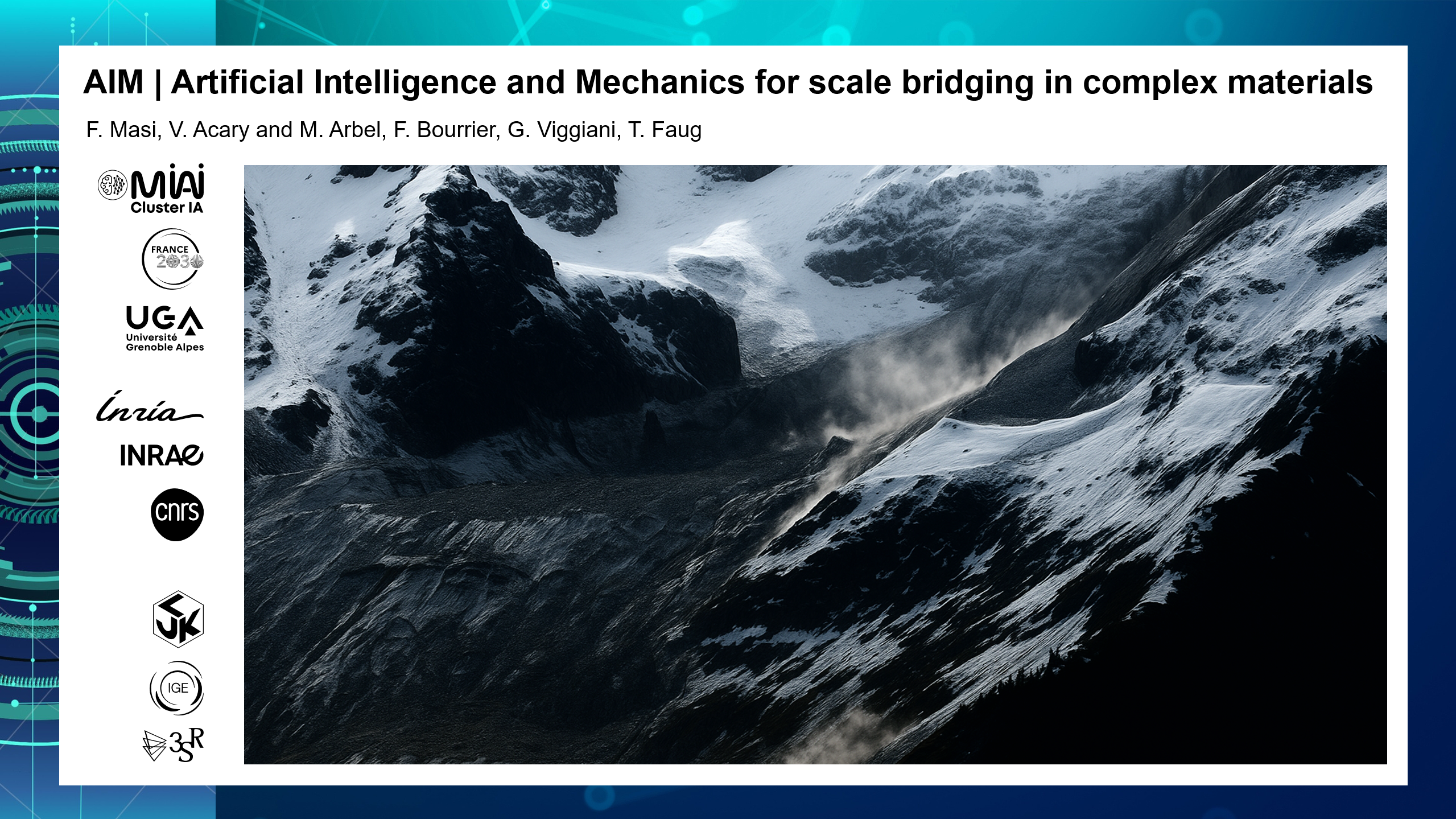

Granular materials exhibit complex, nonsmooth, and multiscale behaviors that pose significant challenges to current predictive models and computing resources. Yet these materials are central to a wide range of industrial and environmental processes. Their inherently complex rheology makes their handling, processing, and use highly challenging and energy-intensive. They also play a key role in understanding and mitigating natural hazards such as landslides and avalanches, whose impacts have been intensifying due to climate change.
AIM’s interdisciplinary methodology bridges applied mathematics, mechanics, and artificial intelligence to better understand, model, and predict the mechanics and dynamics of granular media. By combining high-fidelity particle-scale simulations, cutting-edge in-operando experiments, and developing AI methods grounded in the fundamental principles of statistical physics and non-equilibrium thermodynamics, AIM will demonstrate a proof of principle for robustly and accurately predicting the fine- and large-scale behavior of granular systems.
The project will also establish an innovation consortium dedicated to open-source software and develop an interdisciplinary training program at the intersection of AI and mechanics, equipping the next generation of scientists and engineers.
SELECTED LIST OF PUBLICATIONS
F. Masi, I. Einav (2024). Neural integration for constitutive equations using small data. *Computer Methods in Applied Mechanics and Engineering*, 420, 116698.
F. Masi, I. Stefanou (2022). Multiscale modeling of inelastic materials using thermodynamics-based artificial neural networks (TANN). Computer Methods in Applied Mechanics and Engineering, 398, 115190.
M. Arbel, J. Mairal (2022). Non-convex bilevel games with critical point selection maps. Advances in Neural Information Processing Systems, 582, 8013–8026.
F. Masi, I. Stefanou, P. Vannucci, V. Maffi-Berthier (2021). Thermodynamics-based artificial neural networks for constitutive modeling. Journal of the Mechanics and Physics of Solids, 147, 104277.
M. Bińkowski, D.J. Sutherland, M. Arbel, A. Gretton (2018). Demystifying MMD GANs. International Conference on Learning Representations.
F. Dubois, V. Acary, M. Jean (2018). The Contact Dynamics Method: A Nonsmooth Story. *Comptes Rendus Mécanique*, 346(3), 247–262.
V. Acary (2013). Projected event-capturing time-stepping schemes for nonsmooth mechanical systems with unilateral contact and Coulomb friction. *Computer Methods in Applied Mechanics and Engineering*, 256, 224–250.
V. Acary, F. Pérignon (2007). Siconos: A software platform for modeling, simulation, analysis, and control of nonsmooth dynamical systems. SNE Simulation News Europe, 17(3/4), 19–26.
CHAIR PRESENTATION
License: Unless otherwise stated, all documents are shared under the Creative Commons BY-NC-ND 4.0 license. You may view and share them for non-commercial purposes, without modification, and with appropriate credit to the authors.

Published on October 13, 2026 Updated on October 13, 2026
Share the linkCopyCopiedClose the modal windowShare the URL of this pageI recommend this page:Available at this address:The page will then be accessible from your "My Favorites" menu.Stop the videoPlay the videoMutePlay audioChat: Have a question?Robo Fabrica ChatbotMatomo Traffic StatisticsX (formerly Twitter)