Marie Ghis Malfilatre,
CNRS Research Fellow,
marie.ghis-malfilatre@umrpacte.fr
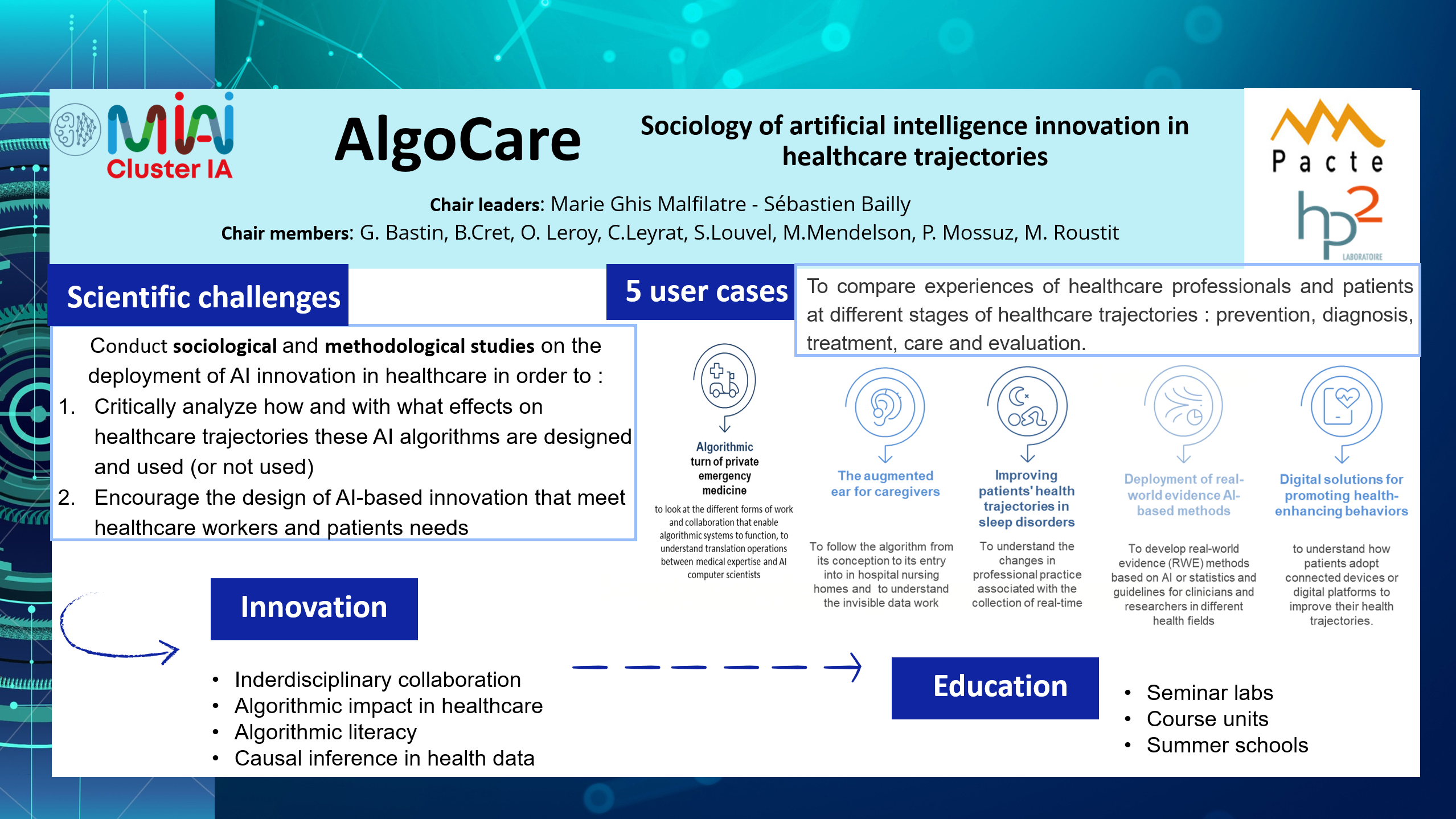
The growing expectations surrounding AI innovations in the healthcare sector call for empirical studies to understand the motivations and experiences of healthcare professionals and patients in designing, adopting, or rejecting these technologies. The Algorithmic Care Chair analyzes the deployment of AI in the healthcare system by coordinating sociological studies on the trajectories of algorithmic innovation across different specialties (e.g., emergency medicine, geriatrics, sleep disorders, physiology, environmental health) and institutions (nursing homes, private practice, hospitals), as well as across the various purposes of algorithms (e.g., diagnostic support, prediction of patient pathways, monitoring, therapeutic strategy support, public health surveillance). This exploration is conducted through the analysis of both existing and emerging use cases.
Using an ethnographic approach (direct observations and qualitative interviews) and combining the sociology of work, the sociology of health and illness, and Science, Technology, and Society (STS), the Algorithmic Care Chair aims to:
1) Study the ways in which algorithms are designed, the “invisible work,” and the new activities and collaborations required throughout the “sociotechnical chain” for AI to function and make sense
2)Understand the contrasting uses, experiences, and evaluations of these systems by different stakeholders, as well as their impact on work organization, professional knowledge, decision-making, and the tensions their deployment may give rise to.
The Algorithmic Care project, drawing on the sociological expertise of the PACTE laboratory, the former Algorithmic Society Chair, and the healthcare AI algorithm expertise of the HP2 laboratory, seeks to thoroughly investigate the algorithmization of health. As part of an interdisciplinary effort, the Chair aims to anticipate the potential social consequences of algorithms by conducting a critical analysis of the design and deployment of these technologies, paying particular attention to their failures, complexity, and unintended consequences. The Chair will also contribute to the broader debate on the limits of technoscientific solutions to the current challenges facing the healthcare system.
A postdoctoral researcher in sociology is expected to be hired to begin an ethnographic study in early 2026. Two additional positions will be posted in 2026.
License:
Unless otherwise stated, all documents are shared under the Creative Commons BY-NC-ND 4.0 license.
You may view and share them for non-commercial purposes, without modification, and with appropriate credit to the authors.