Full Professor at Grenoble Alpes University (UGA), Researcher at the Jean Kuntzmann Laboratory (LJK) as a member of the Inria AIRSEA project team, clementine.prieur@univ-grenoble-alpes.fr
Rodolphe Le Riche,
CNRS Senior Researcher,
Laboratory of Computer Science, Modeling, and Systems Optimization,
rodolphe.le_riche@uca.fr
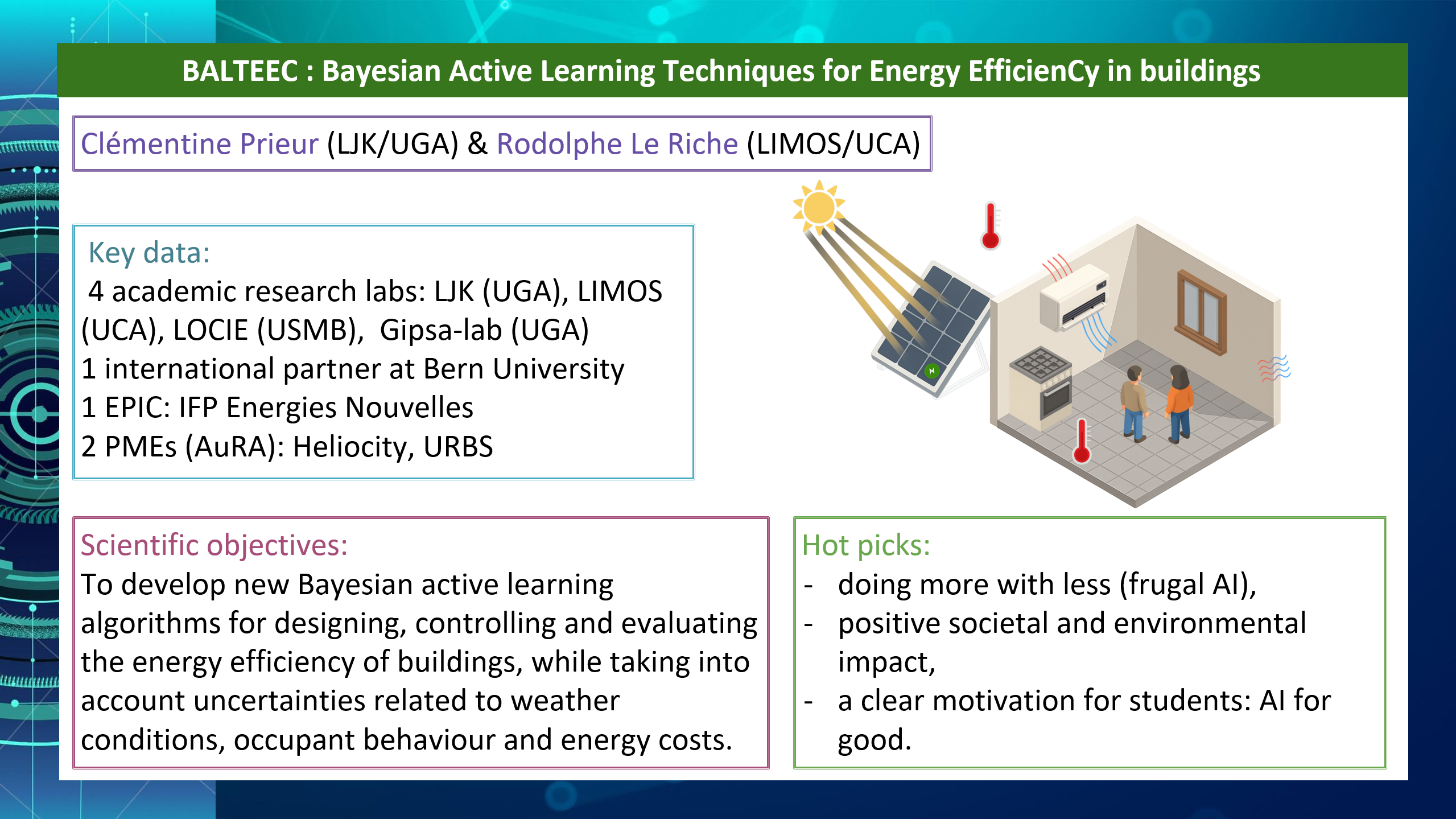
Doing more with less: The main challenge of our project is to design new algorithms capable of adapting online to data structure and model complexity, with a special emphasis on uncertainties. However, the research developments we propose are inspired by and applied to real-world issues of energy efficiency in buildings, offering two advantages: first, the project has a clear environmental impact; second, it provides educational and research applications for AI algorithms that can attract an audience seeking clear, positive societal benefits. The BALTEEC chair project is part of the MIAI Institute’s research axis “Core AI: Machine Learning and Reasoning.”
Work packages:
WP0: Code for test cases based on thermal simulations of buildings
WP1: Active learning for conditional variables—application to the design and verification of energy-efficient renovations
WP2: handling uncertain time series – application to the control and fault diagnosis of energy systems in buildings equipped with a photovoltaic power generator
WP3: classification and multiscale models – application to the detection of energy renovations at the district scale
Innovation:
The BALTEEC project will primarily produce generic Bayesian learning procedures. The associated software prototypes will be available under an open-source license. In addition, the test case platform addressing energy-in-buildings challenges will also be distributed under an open-source license. Some of the algorithms developed—such as those dealing with energy-use predictions—may be of interest to the three industrial partners as potential components of their commercial products. The chair’s intellectual property agreement will allow for this possibility without granting exclusivity, in order to promote open science within the BALTEEC chair.
The BALTEEC Chair is launching this fall semester of 2025:
A PhD student has been hired to work on WP1 starting in November 2025:
We are hiring: a one-year postdoctoral position is available, along with another PhD position.