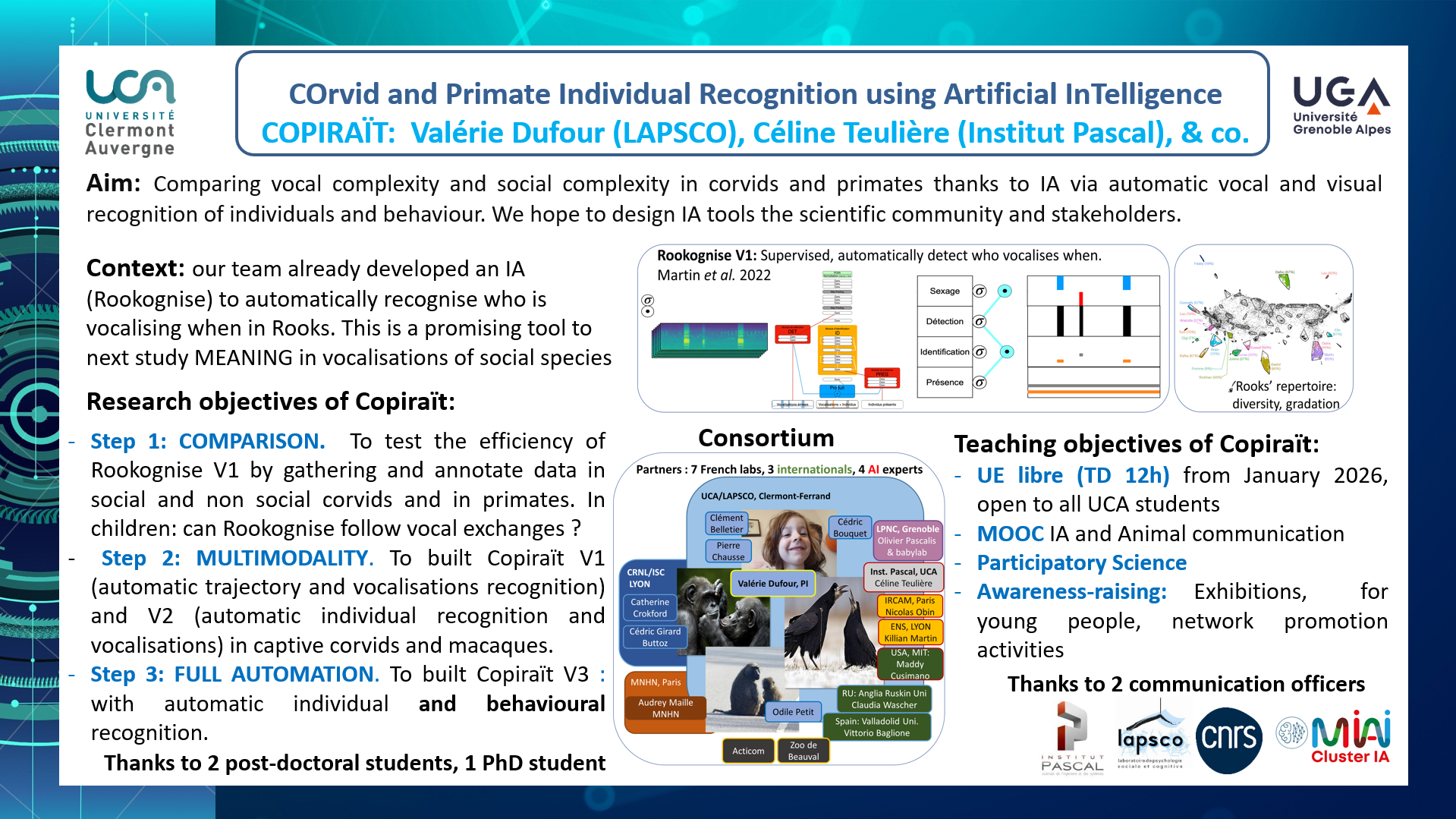
The socio-communicative complexity hypothesis states that living in groups should increase the need for efficient communication in animals. Thanks to “Rookognise,” a multitask neural network designed to automatically recognize which rook is vocalizing and when, we plan to test this hypothesis comparatively—that is, in social and non-social corvids, as well as in human and non-human primates. Rookognise needs to be adapted for non-bird species and enhanced with visual recognition of individuals and behaviors. This project should help identify key factors in the evolution of language (sociality, cognition, vocal learning) that are shared by corvids and primates. It will also help identify key communicative behaviors in children and their role in the formation of social networks and, more generally, the link between vocal and social integration. Finally, this project also holds significant innovative potential for education, animal conservation, and animal welfare.
ACTIVITIES
We plan to hire two postdoctoral researchers and a Ph.D. student. We plan to develop a research platform to facilitate the sharing of both behavioral data and AI code. We also plan to offer several training sessions (online or open to the public) to demonstrate how AI can help us better understand the evolution of communication and the diversity of behaviors in other species.
CHAIR PRESENTATION
License: Unless otherwise stated, all documents are shared under the Creative Commons BY-NC-ND 4.0 license. You may view and share them for non-commercial purposes, without modification, and with appropriate credit to the authors.
Published on October 13, 2026 Updated on October 13, 2026
Core members
Valérie Dufour
Céline Teulière
Cédric Bouquet
Clément Belletier
Pierre Chausse
Associate members
Vittorio Baglione
Catherine Crockford
Maddi Cusimano
Xavier Desquesne
Bruno Emile
Cédric Girard-Buttoz
Audrey Maille
Killian Martin
Nicolas Obin
Olivier Pascalis
Odile Petit
Olivier Pietquin
Claudia Wascher.
Research Topics
AI and Life Sciences, Automatic Detection, Multimodality, Vocalization, Behavior, Corvids, Monkeys
Share the linkCopyCopiedClose the modal windowShare the URL of this pageI recommend this page:Available at this address:The page will then be accessible from your "My Favorites" menu.Stop the videoPlay the videoMutePlay audioChat: Have a question?Robo Fabrica ChatbotMatomo Traffic StatisticsX (formerly Twitter)