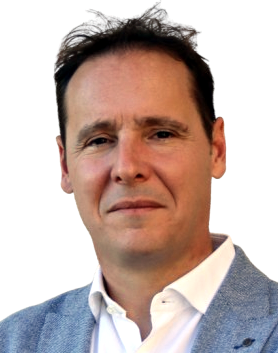
 Aurélien Gourrier,
CNRS Research Director,
aurelien.gourrier@cnrs.fr
DESCRIPTION
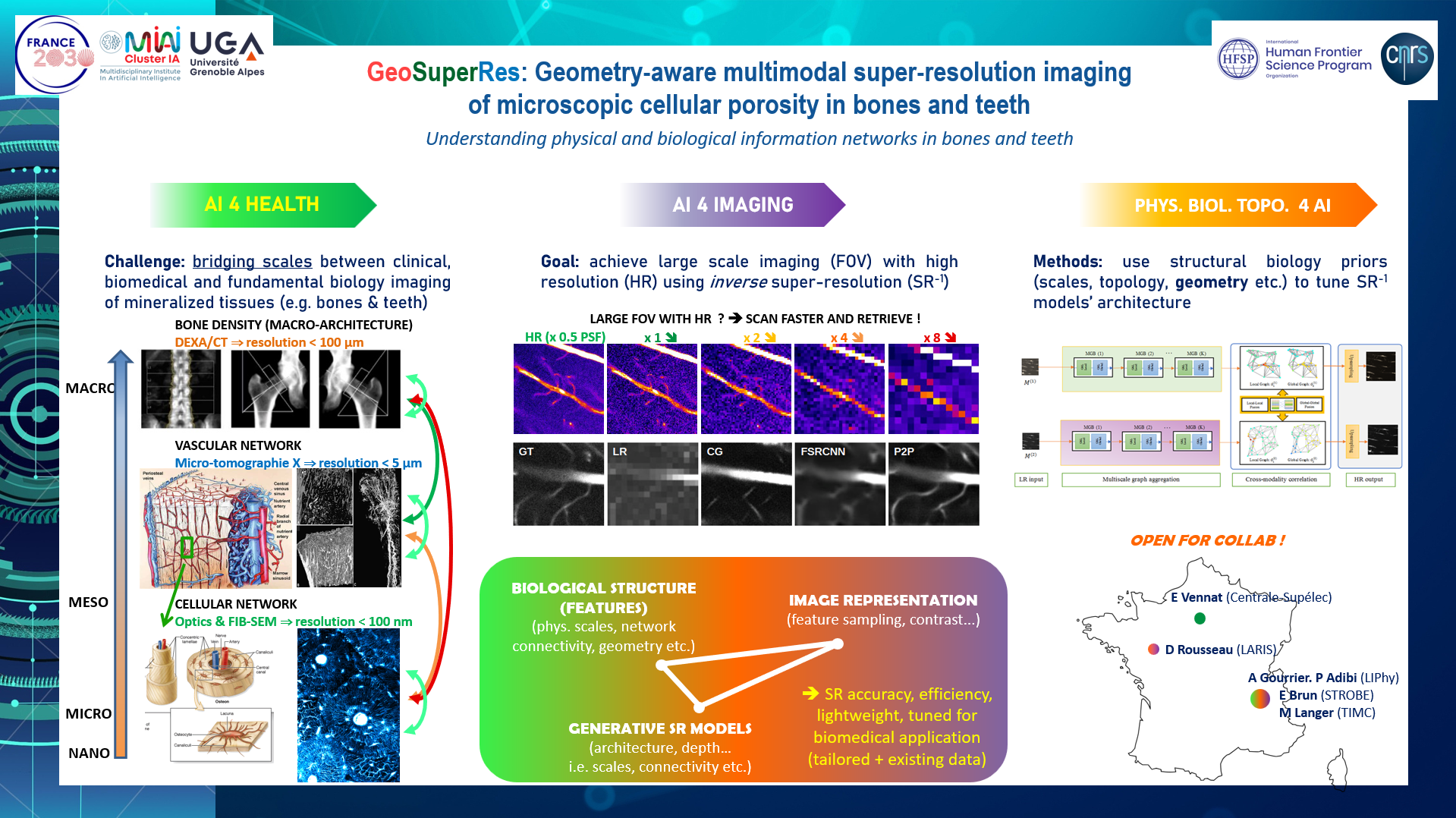
This MIAI Chair aims to address a fundamental dilemma in biomedical imaging: choosing between visualizing fine microscopic details of a small biopsy and obtaining a very coarse view of the entire organ. Both options generally require different instruments that must be combined to fully elucidate the structure. Such correlative imaging typically involves significant operational and infrastructure costs.
Deep learning super-resolution (SR) can help achieve this goal by combining modalities with different resolving powers. Many SR models have been proposed, but their generalizability is far from obvious. We believe that substantial improvements could be made by incorporating structural biology information into the models. Our target application is the analysis of microscopic cell networks in bones and teeth, diseases of which place a major burden on public health systems. Such systems exhibit specific network topology and geometric characteristics that will help design more efficient and lighter SR models that could be applied to broader classes of physical networks.
The chair is supported by a highly interdisciplinary team with extensive expertise in bioimaging, medical analysis, and AI for computer vision, as well as extensive experience in industrial transfer.
Please feel free to share your interests and reach out to us at any time!
ACTIVITIES
We are very pleased to announce that Prof. Peyman Adibi from Isfahan University has now joined the team through at least 2027! His extensive expertise in AI problems related to computer vision will be a major asset in the development of SR.
A PhD position will open in June 2026, and a junior postdoc position will also be announced in 2026, so stay tuned!
EVENTS
The first chair events will be announced in the fall of 2025.
MORE ABOUT CORE AND ASSOCIATED MEMBERS:
Core Members:
Aurélien Gourrier is serving as chair. He is a CNRS Research Director at the Laboratory for Interdisciplinary Physics (LIPhy), a joint unit of the CNRS and the University of Grenoble Alpes. He has extensive expertise in imaging methods and instrumentation, biophysics, and biomedical studies of mineralized tissue.
Emmanuel Brun, is an INSERM Research Director at the Laboratory of Synchrotron Radiation for Biomedicine (STROBE), a joint INSERM unit with the University of Grenoble Alpes. He is an expert in X-ray medical imaging with a broad interest in image physics and translational research.
Max Langer is a CNRS Research Fellow based at the Translational Research and Innovation in Medicine and Complexity (TIMC) Laboratory of the CNRS and the University of Grenoble Alpes. He is a physicist and specialist in image reconstruction and inverse problems—including those involving AI methods—with extensive expertise in synchrotron X-ray phase-contrast methods.
Elsa Vennat She is a professor at Centrale-Supélec and is based at the Laboratory of Mechanics of Paris-Saclay (LMPS), a joint unit of the University of Paris-Saclay, ENS Paris-Saclay, Centrale-Supélec, and the CNRS. She is an expert in numerical mechanical modeling of materials and biomaterials, in biomechanics, and in biomedical studies of teeth in particular.
David Rousseau He is a professor at the University of Angers and leads research at the Angers Regional Laboratory for Research in Systems Engineering (LARIS). He is an expert in computer vision and AI with extensive expertise in imaging systems, including unconventional imaging.
Associate members:
Peyman Adibi is a professor at Isfahan University who is currently a visiting scholar at LIPhy. He is a renowned expert in AI for computer vision applications with a broad interest in topology-informed machine learning.
CHAIR PRESENTATION
License:
Unless otherwise stated, all documents are shared under the Creative Commons BY-NC-ND 4.0 license.
You may view and share them for non-commercial purposes, without modification, and with appropriate credit to the authors.



