

Julie Dugdale,
UGA Professor,
Julie.Dugdale@univ-greanoble-alpes.fr

Cécile Cornou
Research Director, IRD,
Cecile.Cornou@univ-grenoble-alpes.fr
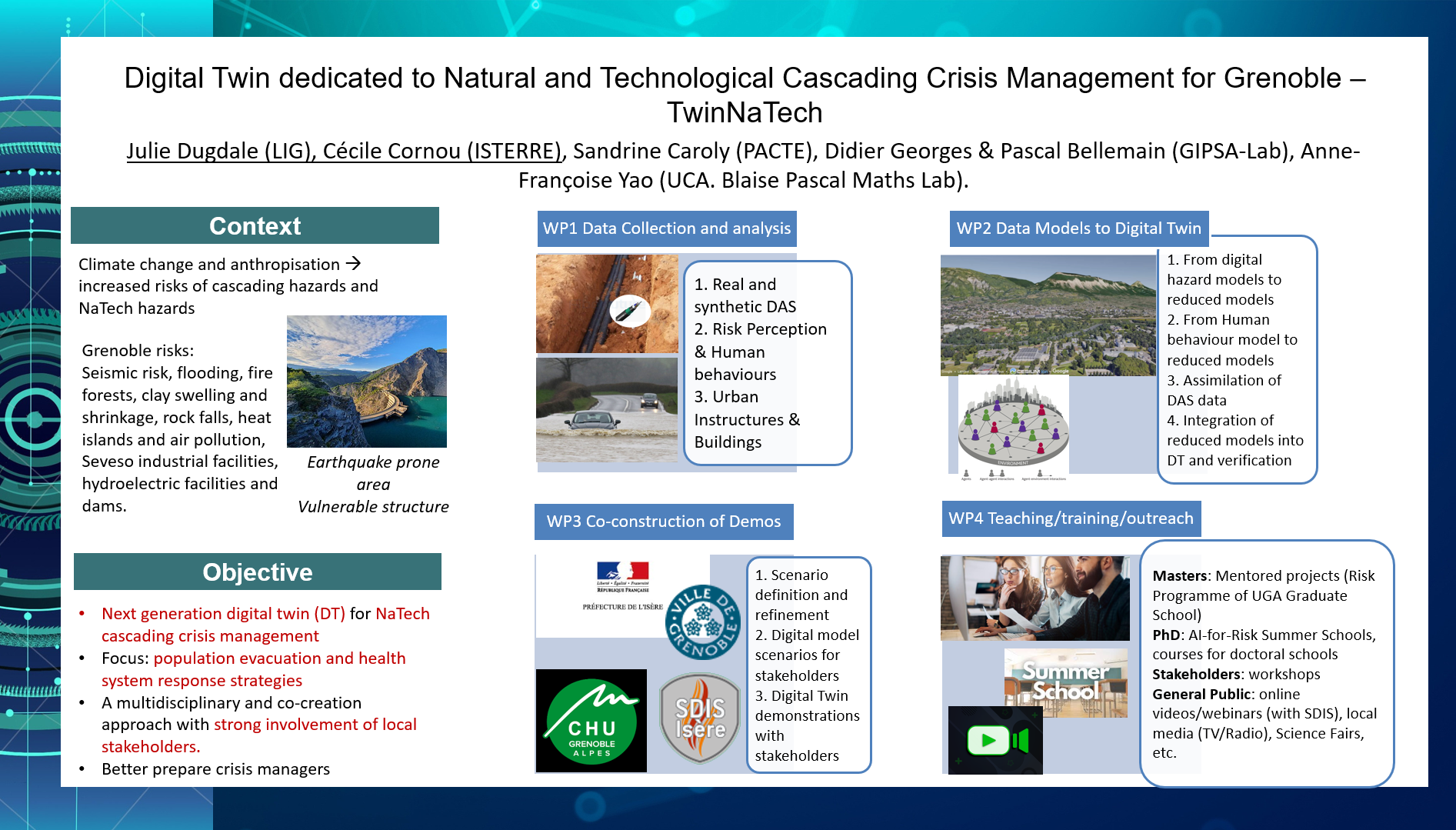
The effects of climate change, combined with human-induced changes, have increased the risks posed by natural and technological (NaTech) hazards. Anticipating and responding to such crises is challenging for crisis managers, who can be better supported by intelligent digital tools. Using a multidisciplinary and co-creation approach, we will develop an innovative next-generation digital twin (DT) for managing NaTech cascading crises in the city of Grenoble. The focus is on population evacuation and health system response strategies, with the active involvement of local stakeholders who are full members of the project (i.e., Grenoble University Hospital, the Departmental Fire and Rescue Service—SDIS38, and the City Council of Grenoble). The DT will incorporate a priori and real-time data (using innovative distributed acoustic sensing) and surrogate/reduced-order models, including human-behavior models.
The objectives are: to help crisis managers and decision-makers better prepare their crisis response plans; to develop theoretical foundations and skills in NaTech and AI applications; and to increase the population’s risk awareness. Training will be provided to stakeholders and decision-makers, students, and the general public through summer schools, videos, and webinars; mentored research projects; doctoral school training courses; and dedicated training sessions.
The chair is organized into three work packages. One Ph.D. student and two postdocs will be hired.
Objectives: Collect and analyze the physical, social, and behavioral data needed for the Digital Twin
Objectives: Iteratively develop the DT using digital models that incorporate hazard models, human behavior models, and Distributed Acoustic Sensing data
Objectives: Co-creation and demonstration of digital models, scenarios, and digital twins with stakeholders
Keynote: “Beyond Rationality: Unveiling Human Behavior in Crisis Evacuations Through Agent-Based Simulation.” Julie Dugdale. International Conference on Information Systems for Crisis Response and Management (ISCRAM 2024), Münster, Germany.
Keynote: “Human Behavior in Crisis Situations – Modeling and Simulation.” Julie Dugdale. International Conference on Information Technology for Disaster Risk Reduction (ITDRR 2023). Tokyo, Japan.
Keynote: “Optimal Sensor Placement,” Didier Georges. Mathematics & Geosciences Workshop 2024. Chambéry, France.
Abdillahi Isman, M., Nefzi, W., Mbaye, P., Khardani, S., & Yao, A. F. (2024). Kernel density estimation for a stochastic process with values in a Riemannian manifold. Journal of Nonparametric Statistics, 37(2), 344–363. https://doi.org/10.1080/10485252.2024.2382442
Ah-Pine, J., Yao, A-F., “On Using Derivatives and Multiple Kernel Methods for Clustering and Classifying Functional Data,” Neurocomputing, Volume 621, 2025, 129231, ISSN 0925-2312, https://doi.org/10.1016/j.neucom.2024.129231.
Belhadjoudja, C., M. Maghenem, E. Witrant, D. Georges, “Boundary control for wildfire mitigation,” accepted for presentation at the IEEE Conference on Decision and Control 2024, Rio de Janeiro, 2025.
Caroly, S., Weissbrodt, R., Ravanel, L., & Bodin, X. (2024). Climate Change and Risks Associated with Permafrost Degradation: What Are the Methodological Challenges in Ergonomics? Activités, (21-2). https://doi.org/10.4000/12huh
Caroly, S. (2022). The Body and Risk Management in Collective Activity. Toulouse: Octarès, 978-2-23330-128-1
Caroly, S., & Bonneterre, V. (2022). Cooperation in Hospital Crisis Teams and Regional Healthcare Networks. Proceedings of the 56th SELF Congress, July 6–8, Geneva, pp. 560–56, https://ergonomie-self.org/wp-content/uploads/2022/05/contribution-261-final-b.pdf
Causse, M., Cornou, C., Maufroy, E., Grasso, J., Baillet, L., & El Haber, E., 2021. Exceptional ground motion during the shallow Mw 4.9 2019 Le Teil Earthquake, France, *Communications Earth and Environment*, *Commun Earth Environ* 2, 14 (2021). https://doi.org/10.1038/s43247-020-00089-0
Georges, D. “Toward Optimal Architectures for Hazard Monitoring Based on Sensor Networks and Crowdsensing.” IDRiM Journal 10 (1): 104–46 (2020). https://doi.org/10.5595/001c.17963
Georges, D. “Wildfire Mitigation Using an Aerial Firefighting Vehicle: An Optimal Control Approach,” accepted for presentation at the IEEE Conference on Decision and Control 2024, Rio de Janeiro, 2025.
Hansen, A. F., Hasle, P., Caroly, S., Reinhold, K., Järvis, M., Herrig, A. O., ... & Jensen Stochkendahl, M. (2024). Participatory ergonomics: What works for whom and why? A realist review. Ergonomics, 67(1), 13–33.
Hobiger, M., C. Cornou, P.-Y. Bard, N. Le Bihan, 2011. MUSIQUE: A quaternion-based array processing technique for surface wave polarization analysis, 2011 IEEE Statistical Signal Processing Workshop (SSP), June 28–30, 2011, pp. 5–8
Iskandar, R., B. Al Tfaily, C. Cornou, P.-Y. Bard, B. Guillier, J. Harb, P. Lacroix, J. Adjizian-Gérard, E. Beck, J. Dugdale, C. Salameh, N. Saliba, 2023. Estimating Urban Seismic Damage and Debris from Building-Level Simulations: Application to the City of Beirut, Lebanon, Bull. Earthquake Engineering, 10.1007/s10518-023-01768-x
Iskandar, Rouba, Julie Dugdale, Elise Beck, and Cécile Cornou. "Agent-based simulation of a seismic crisis incorporating human behavior: application to the city of Beirut, Lebanon." Simulation 100, no. 4 (2024): 357-377.
Konaté, M.A., Yao, A-F, Château, T., and Bouges, P. "Toward Industrial Use of Continual Learning: A Proposal for New Metrics for Class Incremental Learning," 2023 International Joint Conference on Neural Networks (IJCNN), Gold Coast, Australia, 2023, pp. 01–07, doi: 10.1109/IJCNN54540.2023.10191657.
Moradi, Hossein, Rouba Iskandar, Sebastian Rodriguez, Dhirendra Singh, Julie Dugdale, Dimitrios Tzempelikos, Athanasios Sfetsos, et al. "Improving Evacuation Policies through Agent-Based Modeling and Stakeholder Engagement in Hazard-Prone Areas." International Journal of Disaster Risk Reduction (2025): 105280.
Moradi, Hossein, Rouba Iskandar, Sebastian Rodriguez, Dhirendra Singh, Julie Dugdale, Dimitrios Tzempelikos, and Athanasios Sfetsos. "A Framework for Constructing Agent-Based Models for Evaluating Emergency Evacuation Procedures: A Case Study Applied to Egaleo, Greece." In 58th Hawaii International Conference on System Sciences. 2025.
Sierra, A., Cornou, C., Hechmi, A., Ferjani, S., 2024. “Reflecting on Future Crises in the Urban Environment: The Case of the Tunis Port Area,” Bulletin of the Association of French Geographers, 491–506.
Weissbrodt, R., Caroly, S., Pisoeiro, J. M., Ravanel, L., & Bodin, X. (2024). Roles and Activities of Local Stakeholders Facing Alpine Permafrost Warming: A Comparative Exploratory Analysis of Three Contexts and Networks of Actors. Climate Risk Management, 44, 100591, https://doi.org/10.1016/j.crm.2024.100591
License:
Unless otherwise stated, all documents are shared under the Creative Commons BY-NC-ND 4.0 license.
You may view and share them for non-commercial purposes, without modification, and with appropriate credit to the authors.

