
Sophie Giffard-Roisin
Chercheur, IRD, ISTerre, Grenoble
sophie.giffard@univ-grenoble-alpes.fr
Jocelyn Chanussot
Directeur de recherche, INRIA, Grenoble
Jocelyn.chanussot@inria.fr
Yajing Yan
Professeur associé, LISTIC, Annecy
yajing.yan@univ-smb.fr
DESCRIPTION
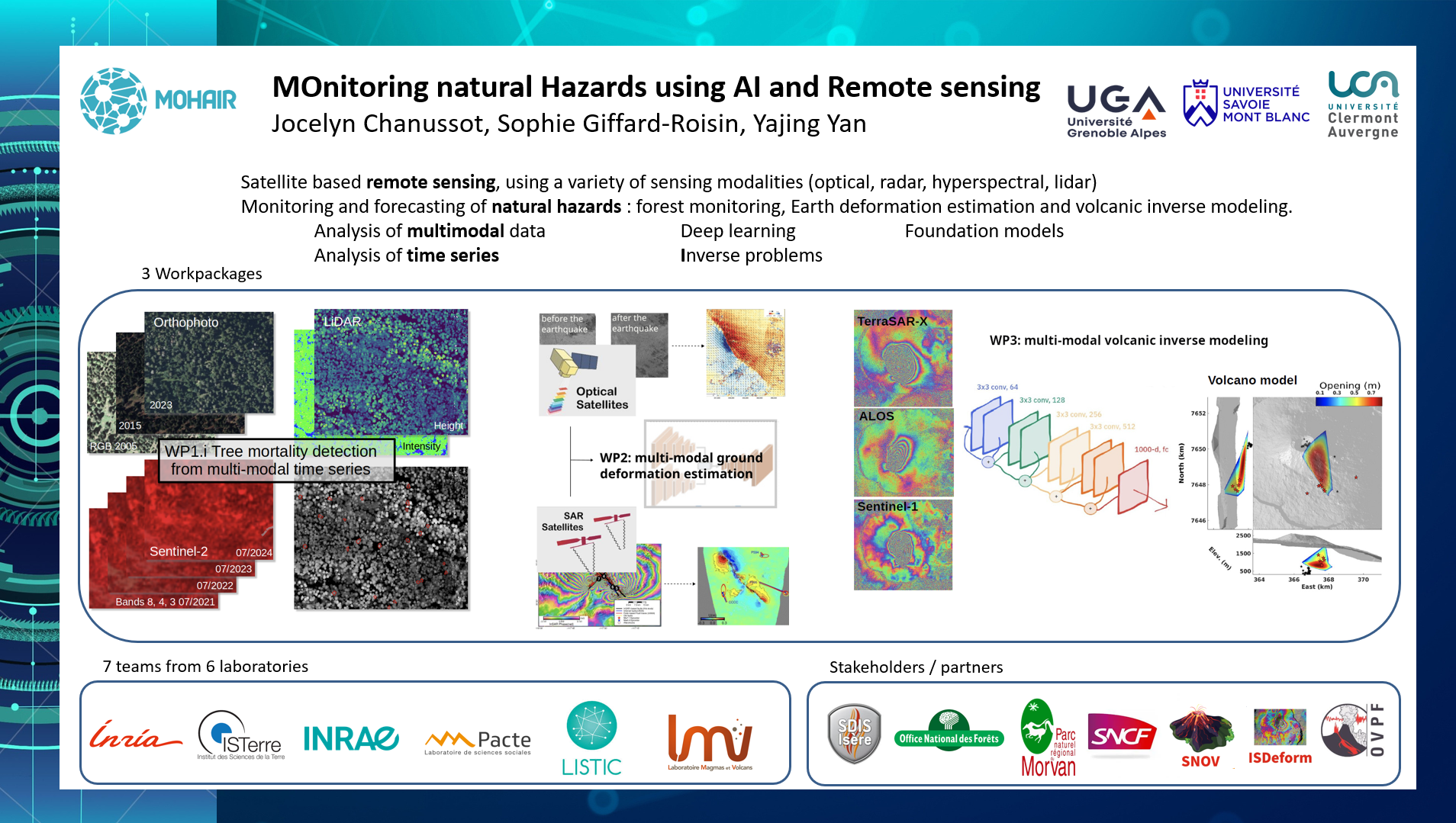
La télédétection par satellite, qui utilise diverses modalités de détection (optique, radar, hyperspectrale, lidar), offre une source unique d'informations pour surveiller l'environnement, avec une résolution spatiale fine, une large couverture et des revisites fréquentes. Cela permet de relever le défi de la surveillance et de la prévision des risques naturels, qui ont un impact sociétal important. Pour exploiter pleinement le potentiel des données de télédétection, il faut développer des algorithmes avancés d'apprentissage automatique, d'apprentissage profond ou, plus généralement, d'intelligence artificielle. Réunissant une équipe interdisciplinaire d'experts, issus de la science des données, des sciences de l'environnement et de la Terre, ainsi que des sciences sociales, cette chaire se concentrera sur trois sujets importants : la surveillance des forêts, l'estimation de la déformation de la Terre et la modélisation inverse du volcanisme. D'un point de vue méthodologique, des recherches seront menées sur l'analyse de l'apprentissage profond multimodal et des séries temporelles, sur les problèmes inverses d'apprentissage profond et sur les modèles de fondation.
ACTIVITÉS
La chaire est organisée en 3 lots de travail avec un total de 6 tâches principales. 4 doctorants seront recrutés ainsi que quelques post-doctorants et stagiaires.
WP1 : Télédétection, IA et foresterie
- Mortalité des arbres dans les forêts de montagne face à l'augmentation du risque d'incendie
- Implantation socio-spatiale des arbres de Noël du Morvan
WP2 : Multimodalité pour l'estimation de la déformation de la terre
- Estimation multimodale des champs de déplacement de la terre : application à l'étude de l'impact sur l'environnement.
- les tremblements de terre.
- Surveillance des zones à risque critique à proximité des infrastructures
WP3 : Modélisation inverse des phénomènes volcaniques
- Estimation rapide des paramètres des modèles volcaniques
- Classification rapide des mécanismes volcaniques
ÉVÉNEMENTS DE LA PRÉSIDENCE
Participation aux MIAI Days, 19-20 juin 2025
La réunion de lancement a eu lieu le 23 juin 2025.
Si vous faites partie d'un des partenaires du Cluster MIAI (à Grenoble/Annecy/Clermond-Ferrand), vous êtes invités à participer aux réunions sur l'apprentissage automatique et les géosciences organisées par le Cluster MIAI (à Grenoble/Annecy/Clermond-Ferrand).
Chaise MOHAIR, une semaine sur deux, le mardi à 16 heures, en personne à ISTerre Grenoble ou sur zoom.
Pour cela, il suffit de s'inscrire à la liste de diffusion AI-geoscience :
https://listes.univ-grenoble-alpes.fr/sympa/info/ai-geoscience
LISTE SÉLECTIVE DE PUBLICATIONS
- [1] Dutrieux, R., Ose, K., de Boissieu, F., Féret, J.-B., 2024. fordead: a python package for vegetation anomalies detection from SENTINEL-2 images. https://doi.org/10.5281/zenodo.12802456
- [2] Tolan, J., Yang, H.I., Nosarzewski, B., Couairon, G., Vo, H.V., Brandt, J., Spore, J., Majumdar, S., Haziza, D., Vamaraju, J. and Moutakanni, T., 2024. Very high resolution canopy height maps from RGB imagery using self-supervised vision transformer and convolutional decoder trained on aerial lidar. Remote Sensing of Environment, 300, p.113888
- [3] Hong, D., Gao, L., Yokoya, N., Yao, J., Chanussot, J., Du, Q., & Zhang, B. (2020). More diverse means better: Multimodal deep learning meets remote-sensing imagery classification. IEEE Transactions on Geoscience and Remote Sensing, 59(5), 4340-4354.
- [4] Guo, X., et al. "Skysense: A multi-modal remote sensing foundation model towards universal interpretation for earth observation imagery." Proceedings of the IEEE/CVF Conference on Computer Vision and Pattern Recognition.
- [5] Lacoste, A., et al. "Geo-bench: Toward foundation models for earth monitoring." Advances in Neural Information Processing Systems 36 (2024).
- [6] Ilg, E., et al. "Flownet 2.0: Evolution of optical flow estimation with deep networks." Proceedings of the IEEE conference on computer vision and pattern recognition. 2017.
- [7] Teed Z., and Jia Deng. "Raft: Recurrent all-pairs field transforms for optical flow." Computer Vision–ECCV 2020: 16th European Conference, Glasgow, UK, August 23–28, 2020, Proceedings, Part II 16. Springer International Publishing, 2020.
- [8] Albino, F., Amelung, F., & Gregg, P. (2018). The role of pore fluid pressure on the failure of magma reservoirs: insights from Indonesian and Aleutian arc volcanoes. Journal of Geophysical Research: Solid Earth, 123(2), 1328-1349.
- [9] Dumont, Q., Cayol, V., & Froger, J. L. (2024). Is stress modeling able to forecast intrusions and slip events at Piton de la Fournaise volcano. Earth and Planetary Science Letters, 626, 118494.
- [10] Anantrasirichai, N., Biggs, J., Albino, F., & Bull, D. (2019a). A deep learning approach to detecting volcano deformation from satellite imagery using synthetic datasets. Remote Sensing of Environment, 230, 111179.
- [11] Anantrasirichai, N., Biggs, J., Albino, F., & Bull, D. (2019b). The application of convolutional neural networks to detect slow, sustained deformation in InSAR time series. Geophysical Research Letters, 46(21), 11850-11858.
- [12] Biggs, J., Anantrasirichai, N., Albino, F., Lazecky, M., & Maghsoudi, Y. (2022). Large-scale demonstration of machine learning for the detection of volcanic deformation in Sentinel-1 satellite imagery. Bulletin of Volcanology, 84(12), 100.
- [13] Gaddes, M. E., Hooper, A., & Bagnardi, M. (2019). Using machine learning to automatically detect volcanic unrest in a time series of interferograms. Journal of Geophysical Research: Solid Earth, 124(11), 12304-12322.
- [14] Gaddes, M., Hooper, A., & Albino, F. (2024). Simultaneous classification and location of volcanic deformation in SAR interferograms using a convolutional neural network. Earth and Space Science, 11(6), e2024EA003679.
- [15] Lopez-Uroz L., Yan Y., Benoit A., Albino F., Bouygues P., Giffard-Roisin S., Pinel V., Exploring Deep Learning for Volcanic Source Inversion, IEEE Transactions on Geosciences & Remote Sensing, vol.62, doi: 10.1109/TGRS.2024.3494253
- [16] Lahssini K., Teste F., Dayal K. R., Durrieu S., Ienco D. and Monnet J.-M., "Combining LiDAR Metrics and Sentinel-2 Imagery to Estimate Basal Area and Wood Volume in Complex Forest Environment via Neural Networks," in IEEE Journal of Selected Topics in Applied Earth Observations and Remote Sensing, vol. 15, pp. 4337-4348, 2022, doi: 10.1109/JSTARS.2022.3175609
- [17] Dayal K. R., Durrieu S., Lahssini K., Ienco D. and Monnet J.-M., "Enhancing Forest Attribute Prediction by Considering Terrain and Scan Angles From Lidar Point Clouds: A Neural Network Approach," in IEEE Journal of Selected Topics in Applied Earth Observations and Remote Sensing, vol. 16, pp. 3531-3544, 2023, doi:10.1109/JSTARS.2023.3263595
- [18] Montagnon, T., Hollingsworth, J., Pathier, E., Marchandon, M., Dalla Mura, M., Giffard-Roisin, S., & Dalla, Mura. (2024). GeoFlowNet: Fast and Accurate Sub-pixel Displacement Estimation From Optical Satellite Images based on Deep Learning.
- [19] Okada, Y. (1985). Surface deformation due to shear and tensile faults in a half-space. Bulletin of the seismological society of America, 75(4), 1135-1154.
- [20] - Cayol V., Carry T., Michon L, Chaput M., Famin V., Bodart O., Froger J.L., Romagnoli C. (2014), Sheared sheet intrusions as mechanism for lateral flank displacement on basaltic volcanoes: Applications to Réunion Island volcanoes, Journal of Geophysical Research, 119, 7607-7635.
- [21] Dumont, Q., Cayol, V., Froger, J. L., & Peltier, A. (2022). 22 years of satellite imagery reveal a major destabilization structure at Piton de la Fournaise. Nature communications, 13(1), 2649.
PRÉSENTATION DE LA PRÉSIDENCE
Licence :
Sauf indication contraire, tous les documents sont partagés sous la licence Creative Commons BY-NC-ND 4.0.
Vous pouvez les consulter et les partager à des fins non commerciales, sans les modifier et en mentionnant les auteurs.