AI4ARCHI: AI for generative architectural and urban design


Prof. Benjamin LECOUTEUX,
benjamin.lecouteux@univ-grenoble-alpes.fr

Website


Prof. Philippe MARIN,
philippe.marin@grenoble.archi.fr 

Website


DESCRIPTION

The construction and architectural sectors are struggling to embrace digital transformation, and regulatory bodies have identified the need to support the sector’s transformation by fostering the development of new knowledge and technical skills. The sector accounts for 30% of Europe’s environmental footprint, making it one of the main contributors. It is essential to give greater consideration to environmental issues right from the initial design phases.

AI plays a key role in these issues. In this context, the project has two objectives:

To contribute to the “capabilities” of designers and address the training challenges facing architecture schools and professionals;

To contribute to the design of a more environmentally friendly built environment by leveraging the qualities of AI systems. 

Three main scientific challenges have been identified:

In terms of architectural sciences: Reframing computational co-creativity, considering the effects and role of language in the design process, and integrating environmental performance from the very beginning of the design phases.

In terms of computer sciences: Adapting language models (LLMs) to architecture-specific tasks by combining them with domain-specific data and appropriately evaluating their performance and ethical implications.

In terms of engineering sciences: Optimizing solar production and solar system designs is a complex task involving a multi-criteria optimization problem that considers heterogeneous parameters such as PV production, usage, structure, comfort, energy, solar potential, and local climate. AI facilitates these activities and speeds up simulation processes.

ACTIVITIES

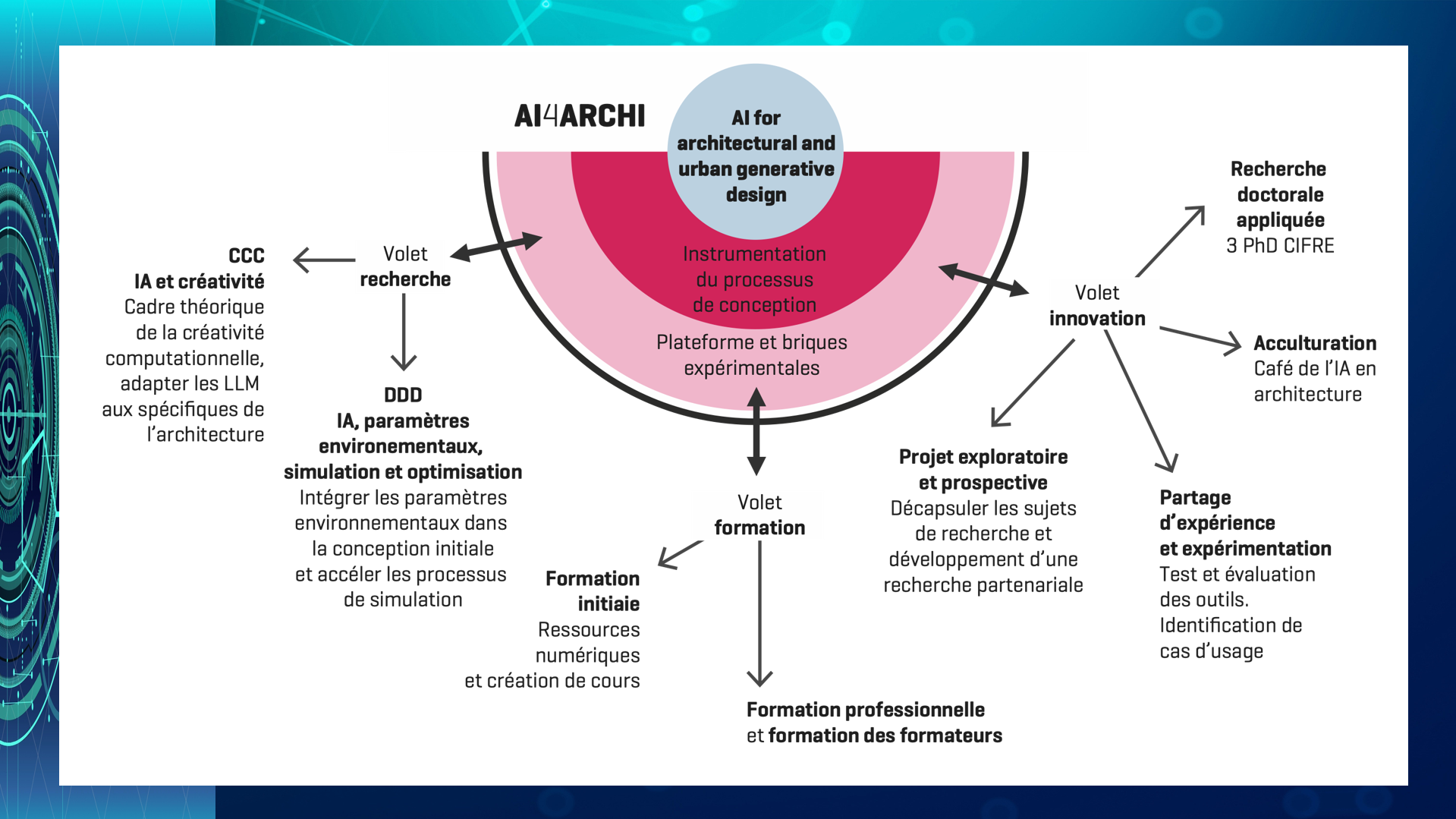
The chair is organized around three packs:

The research pack is structured around two axes:

Computational Co-Creativity (CCC): AI and creativity: How LLMs can support humans in design (impacts and modalities of language interactions for representation production).
Data-Driven Design (DDD): AI simulation and optimization: How to predict shape based on performance requirements and integrate environmental parameters into generative design processes.

The training pack has three components:

  • Initial training: Production of digital resources for students in the fields of architecture, engineering, and communication
  • Training of Trainers: Development of Digital Resources for Professors and Lecturers at French Schools of Architecture
  • Specialized training: Establish a new Master 2 degree program in generative design, a collaboration between UGA and ENSAG.

The innovation pack covers four main activities:

  • Applied and Hosted Research: Scientific Collaboration and CIFRE PhD Programs.
  • Sharing and experimentation workshops: Share best practices, real-life case studies, and/or participate in tool evaluations.
  • Awareness-raising events: Promote and raise awareness of the sector.
  • Exploratory workshops: Organization of open innovation projects to encourage and unlock future research and development and innovation partnerships.
 

SELECTED LIST OF PUBLICATIONS

  • A. Pupier, M. Coavoux, J. Goulian, and B. Lecouteux, “Growing Trees on Sounds: Assessing Strategies for End-to-End Dependency Parsing of Speech,” in ACL 2024 (L.-W. Ku, A. Martins, and V. Srikumar, eds.), vol. 2, (Bangkok, Thailand), pp. 225–233, Aug. 2024.
  • L. Ormaechea-Grijalba, N. Tsourakis, D. Schwab, P. Bouillon, and B. Lecouteux, “Toward High-Quality LLM-Based Data for French Spontaneous Speech Simplification: An Exo-Refinement Approach,” in Interspeech, (Rotterdam (NL), Netherlands), 2025
  • C. Macaire, C. Dion, D. Schwab, B. Lecouteux, and E. Esperança-Rodier, “Towards Speech-to-Pictograms Translation,” in Interspeech 2024, (Kos, Greece), pp. 857–861, ISCA, Sept. 2024.
  • P. Marin, “The Materiality of Knowledge in the Context of Artificial Intelligence and Computational Creativity,” *Culture & Recherche*, vol. 148, pp. 47–59, June 2025, doi: https://hal.science/hal-05117537v1.
  • P. Marin, “Technological Mediation in the Age of Artificial Intelligence,” SHS Web Conf., vol. 203, p. 01001, 2024, doi: 10.1051/shsconf/202420301001.
  • P. Marin and L. Lescop, “How IA Challenges Architectural Design,” in *Envisioning Architectural Scales in the Analog and Virtual Representation of Architecture*, Royal Danish Academy—Institute of Architecture and Design—Copenhagen, August 2023, p. 10. doi: 10.60558/eaea16-2023-311.

CHAIR PRESENTATION

AI4ARCHI Presentation

License:

Unless otherwise stated, all documents are shared under the Creative Commons BY-NC-ND 4.0 license.
You may view and share them for non-commercial purposes, without modification, and with appropriate credit to the authors.
Published on October 13, 2026
Updated on October 13, 2026