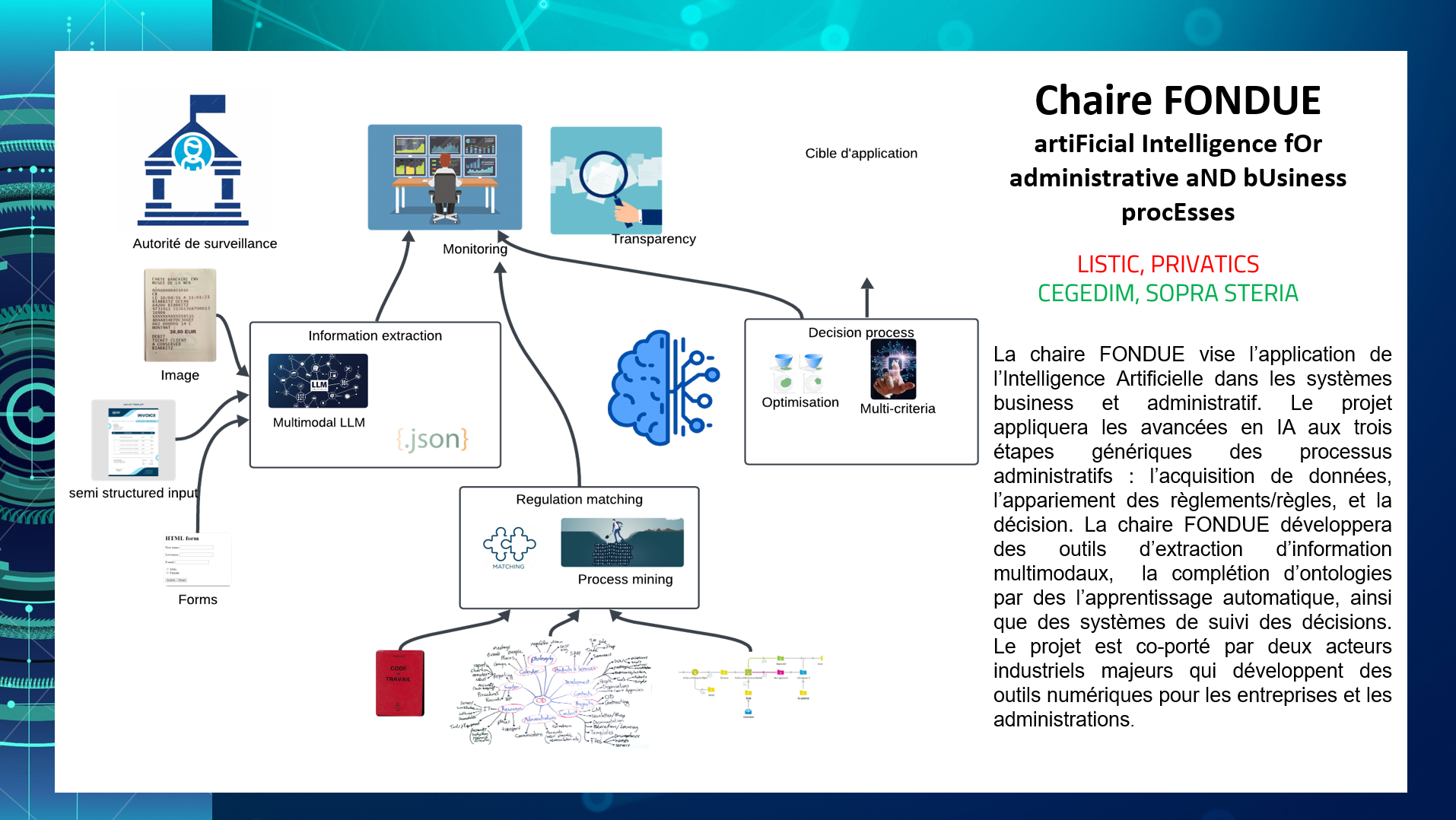
The FONDUE project aims to apply AI-based methodologies to a wide range of contexts relevant to business and administrative processes. Artificial intelligence (AI), such as large language models (LLMs) and expert systems, is transforming business and administrative processes, affecting all three stages of business processes: information retrieval, regulation/rule matching, and decision-making. AI has a significant societal impact but also poses challenges, including bias, ethical concerns, and the risk of reinforcing societal inequalities. Business AI systems must incorporate monitoring components from the design phase to assess ethical, social, and regulatory impacts alongside operational metrics. The FONDUE project aims to apply AI methodologies to improve all stages of business processes while addressing bias and ethical risks. It emphasizes integrating monitoring and evaluation components into AI systems to enhance transparency, explainability, and societal benefits.
The approach taken in the FONDUE project is innovative in that it uses a variety of AI tools to address issues that are frequently overlooked in favor of scientific fields such as health, (geo)physics, and chemistry. The FONDUE approach adopts a distinctly multidisciplinary perspective that combines existing tools and adapts them to the business domain, where human-centered data and processes predominate; designing such AI solutions that incorporate business domain knowledge is challenging, as this knowledge is generally informal and not well characterized. The scope of research addressing domain knowledge representation remains limited, and the project aims to bridge these gaps, however modestly.
This project is supported by two major French companies.
ACTIVITIES
Research aspect: An experimental generic AI pipeline is currently being investigated that incorporates a multimodal information extraction method. This pipeline aims to cover generic building blocks ranging from data extraction to semantic annotation (i.e., labeling). The goal is to design tunable and parameterized AI building blocks; these blocks integrate AI methods suitable for large volumes of unstructured business data.
Education aspect: Several courses have been updated to incorporate AI methods and tools. The BPM course in the Computer Science M.S. curriculum has been completely redesigned: this course now covers AI pipeline engineering for business processes. This pipeline contains AI blocks (LLM, RAG) that process business textual documents as well as unlabeled and unstructured data. The AI pipeline is introduced as a central component of enterprise information systems.
LIST OF SELECTED PUBLICATIONS
Dong Wang, Shaoguang Yan, Yunqing Xia, Kavé Salamatian, Weiwei Deng, and Qi Zhang. 2022. “Learning Supplementary NLP Features for CTR Prediction in Sponsored Search.” Proceedings of the 28th ACM SIGKDD Conference on Knowledge Discovery and Data Mining (KDD '22). ACM.
Dong Wang, Kavé Salamatian, Yunqing Xia, Weiwei Deng, and Qi Zhang. 2023. BERT4CTR: An Efficient Framework for Combining a Pre-trained Language Model with Non-textual Features for CTR Prediction. Proceedings of the 29th ACM SIGKDD Conference on Knowledge Discovery and Data Mining (KDD '23). ACM.
P. Dardouillet, K. Salamatian, H. Verjus, F. Loukil, D. Telisson, and O. L. van, "Strategic Integration of Context for Fine-Tuning Topic Model Performance," 2024 IEEE 48th Annual Computers, Software, and Applications Conference (COMPSAC), Osaka, Japan, 2024, pp. 366–375.
Karima Boutalbi, Rafika Boutalbi, Hervé Verjus, and Kave Salamatian. 2024. “Hierarchical Tensor Clustering for Multiple Graphs Representation.” In Companion Proceedings of the ACM Web Conference 2024 (WWW '24). Association for Computing Machinery, New York, NY, USA, 613–616.
Faiza Loukil, Sarah Cadereau, Hervé Verjus, Mattéo Galfre, Kavé Salamatian, David Telisson, Quentin Kembellec, Olivier Le Van, 2024. “LLM-centric pipeline for information extraction from invoices,” The 2nd International Conference on Foundation and Large Language Models (FLLM2024), November 26–29, 2024, Dubai, UAE
Jason Piquenot, Maxime Bérar, Pierre Héroux, Jean-Yves Ramel, Romain Raveaux, Sébastien Adam. "Finding Path and Cycle Counting Formulae in Graphs Using Deep Reinforcement Learning." CoRR abs/2410.01661 (2024)
Vasisht Duddu, Antoine Boutet, Virat Shejwalkar. Quantifying Privacy Leakage in Graph Embedding. MobiQuitous, 2020.
Boutet, Magnana. “Anonymization by Design of Language Modeling.” arXiv preprint arXiv:. (2024).
CHAIR PRESENTATION
License:
Unless otherwise stated, all documents are shared under the Creative Commons BY-NC-ND 4.0 license.
You may view and share them for non-commercial purposes, without modification, and with appropriate credit to the authors.
Published on September 28, 2026 Updated on September 28, 2026
Core members
Kavé Salamatian, Professor
Hervé Verjus, Associate Professor
Jean-Yves Ramel
Antoine Boutet
Faiza Loukil, Associate Professor
David Telisson, Associate Professor
Associate members
French Companies: Cegedim and Sopra-Steria
Research Topics
Business processes, LLMs and RAGs, Monitoring of AI systems
Share the linkCopyCopiedClose the modal windowShare the URL of this pageI recommend this page:Available at this address:The page will then be accessible from your "My Favorites" menu.Stop the videoPlay the videoMutePlay audioChat: Have a question?Robo Fabrica ChatbotMatomo Traffic StatisticsX (formerly Twitter)