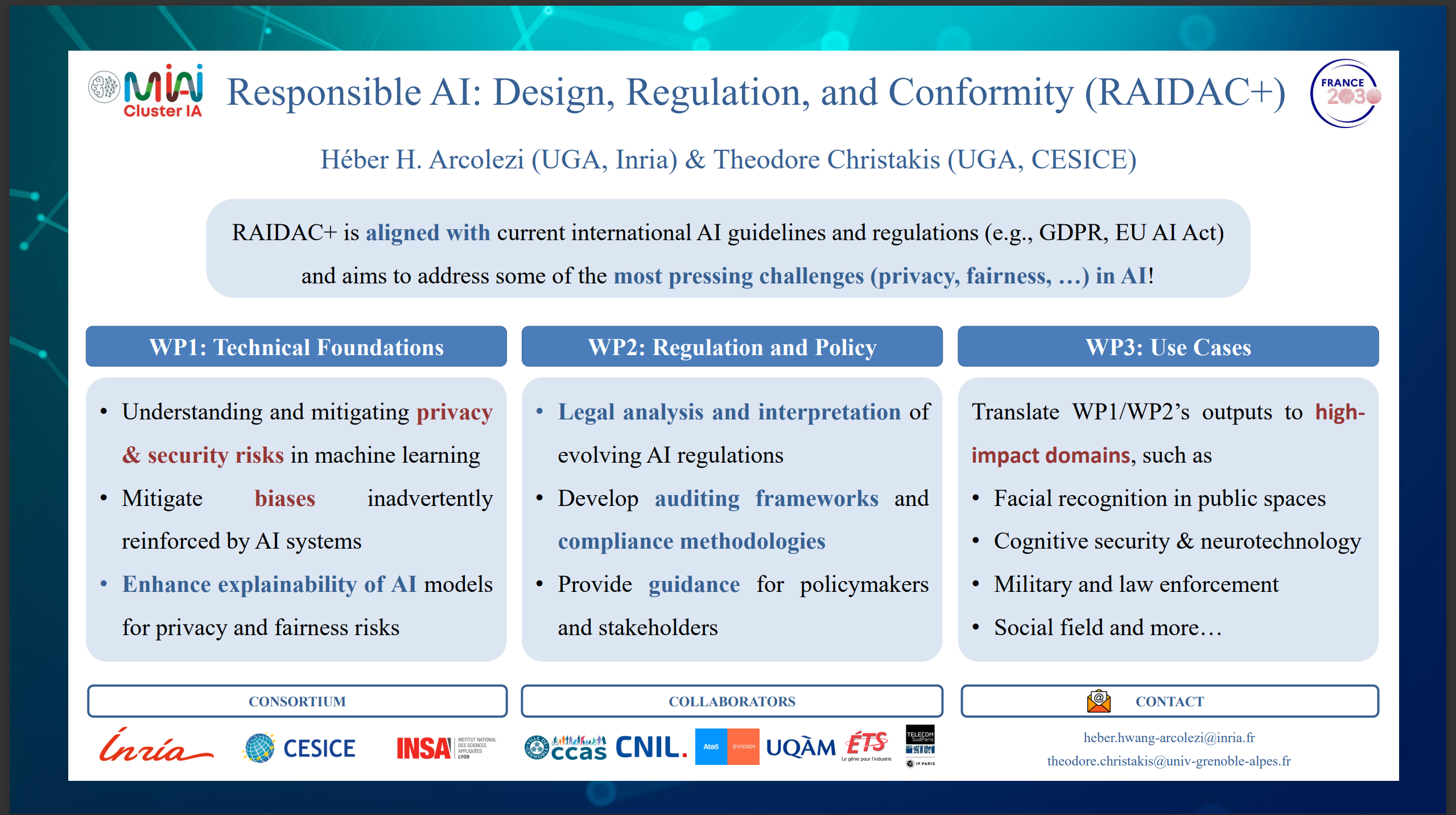
The Responsible AI Chair (RAIDAC+) is a transdisciplinary initiative that integrates pioneering research in AI privacy, fairness, transparency, and robustness with cutting-edge expertise in AI regulation, law, and policy. As AI systems become ubiquitous—governing access to social services, guiding decisions in healthcare, informing public security strategies, and even facilitating novel neurotechnologies—they present us with urgent ethical, legal, and societal challenges. Building on the solid foundations of two distinct yet complementary approaches—(1) the “Responsible AI” project, which focused on privacy risks, fairness, and explainability, and (2) the “Legal and Regulatory Implications of AI” Chair (AI-Regulation.com), which addressed legal and governance frameworks (GDPR, EU AI Act, Law Enforcement Directive, etc.)—RAIDAC+ uniquely brings together computer scientists, legal scholars, and industry partners. Together, we aim to foster data-driven innovation in Europe through ethically sound, legally compliant, and socially beneficial AI technologies.
ACTIVITIES
RAIDAC+ will be actively expanding its research activities, with a particular focus on privacy in emerging technologies. Specifically, the Chair works on developing the technical foundations for responsible AI, including privacy-preserving methods, fairness-aware models, and explainable AI. Furthermore, it analyzes and operationalizes AI regulation and policy, translating complex legal frameworks such as the GDPR and the EU AI Act into actionable guidelines and compliance tools.
Last but not least, the Chair applies these integrated technical and legal strategies to real-world scenarios—such as facial recognition in public spaces, cognitive security, and military applications of AI—to ensure practical applicability and address societal impact.
To support these research activities, the Chair will recruit two research fellows by November 2025, who will work, respectively, on the interplay between the AI Act and the European Health Data Space Regulation (EHDS) and on the implementation of AI governance across the EU. By the end of the same year, we will recruit two Ph.D. students under a co-tutelle agreement with ÉTS Montréal. One student will focus on the technical challenges of privacy explainability, while the other will explore privacy risks associated with brain imaging, with a focus on data publication and sharing. Together, these projects will strengthen our chair’s expertise at the intersection of privacy, data protection, and responsible innovation.
EVENTS
Faculty of Law, Université Grenoble Alpes. (September 19, 2025). Grenoble Law School – IA Week (Grenoble, France) [Conference session “Thinking the Regulation of Emerging Technologies”]. Grenoble, Saint-Martin-d’Hères, France. Université Grenoble Alpes. Event page
Autoriteit Persoonsgegevens. (September 9, 2025). The Dutch Data Protection Authority meets Academia [Conference]. The Hague, Netherlands. The Dutch Data Protection Authority. Event page
Office of the Ambassador for Digital Affairs; Digital Directorate for Education; iSPIRT. (July 3, 2025). In_Fra_Structures 3.0 (Paris, France) [Conference]. Paris, France. Event page
LIST OF SELECTED PUBLICATIONS
Arcolezi, H. H., Alishahi, M., Bendoukha, A. A., & Kaaniche, N. (2025). Fair Play for Individuals, Foul Play for Groups? Auditing Anonymization's Impact on ML Fairness. ECAI 2025.
https://arxiv.org/abs/2505.07985
Boutet, A., & Morel, V. (June 2025). “I’m Not for Sale”—Perceptions and Limited Awareness of Privacy Risks Among Digital Natives Regarding Location Data. In Proceedings of the International AAAI Conference on Web and Social Media (Vol. 19, pp. 277–288). https://doi.org/10.1609/icwsm.v19i1.35816
Karathanasis, T. (2025). Biometric Data and Facial Recognition Technology in the EU. In: Menéndez González, N., Mobilio, G. (eds.) Next Democratic Frontiers for Facial Recognition Technology (FRT). Law, Governance and Technology Series, vol. 74. Springer, Cham.
https://link.springer.com/chapter/10.1007/978-3-031-89794-8_6
Unless otherwise stated, all documents are shared under the Creative Commons BY-NC-ND 4.0 license.
You may view and share them for non-commercial purposes, without modification, and with appropriate credit to the authors.
Share the linkCopyCopiedClose the modal windowShare the URL of this pageI recommend this page:Available at this address:The page will then be accessible from your "My Favorites" menu.Stop the videoPlay the videoMutePlay audioChat: Have a question?Robo Fabrica ChatbotMatomo Traffic StatisticsX (formerly Twitter)