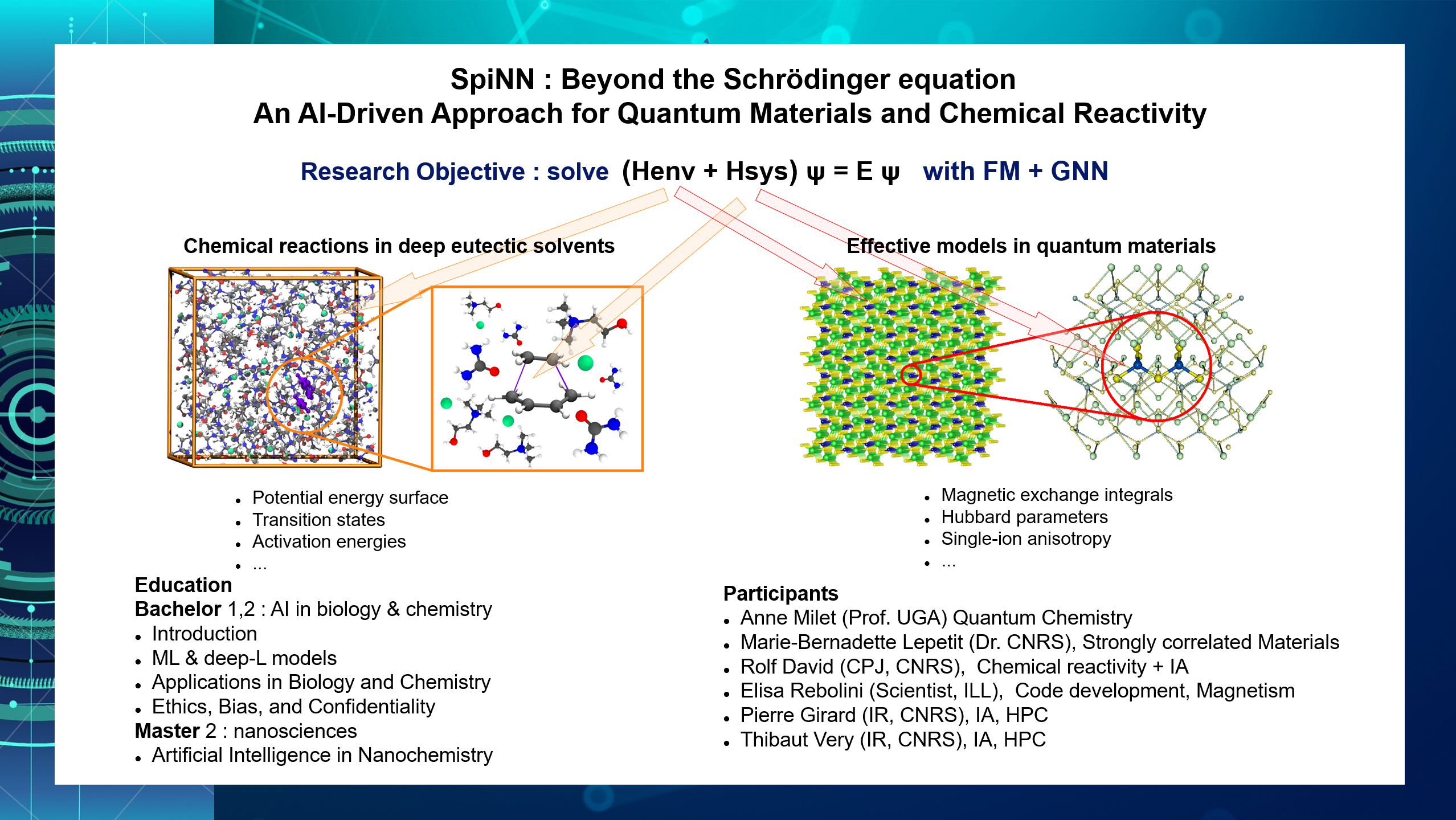
SpiNN - Beyond the Schrödinger equation: an AI-Driven Approach for Quantum Materials and Chemical Reactivity

Marie-Bernadette LEPETIT
Directror of Research at CNRS
Marie-Bernadette.Lepetit@neel.cnrs.fr

Anne Milet
Professeur of Chemistry at UGA
Anne.Milet@univ-grenoble-alpes.fr

DESCRIPTION

This collaborative project has a three-fold objective. The first one is to advance theoretical and methodological developments by leveraging AI to overcome the computational challenges associated with solving the Schrödinger Equation—a fundamental equation in quantum mechanics that governs the behavior of electrons. Specifically, the project focuses on two critical areas: quantum materials and chemical reactivity, where explicitly accounting for the role of electrons is essential, but computationally expensive. The second objective is to apply these AI-driven innovations to derive new physical-chemical insights, deepening our understanding of quantum materials and chemical reactivity. Importantly, this methodology is designed to serve as a model offering a transformative approach that can be extended to tackle similar challenges in computational physics and chemistry. The third objective is to establish protocols for sharing data and open models, ensuring that the project can evolve through collaborations beyond the initial participants. This approach will also help to build a strong reputation for the project, fostering its long-term sustainability and continued growth.

ACTIVITIES

The chair will hire two post-docs. The first one will be hired during fall 2025 will focus on the reactivity in deep eutectic solvents applications. The second one will be hired during spring 2026 and will focus on strongly correlated materials applications.


SELECTED LIST OF PUBLICATIONS

  • David, R. et al. ArcaNN: Automated Enhanced Sampling Generation of Training Sets for Chemically Reactive Machine Learning Interatomic Potentials. Digital Discovery 2025, https://doi.org/10.1039/D4DD00209A.
  • Azom, G.; Milet, A.; David, R.; Kumar, R. From Graphene Oxide to Graphene: Changes in Interfacial Water Structure and Reactivity Using Deep Neural Network Force Fields. J. Phys. Chem. C 2024, 128 (39), 16437–16453.
  • Michel, C.; Laio, A.; Milet, A. Tracing the Entropy along a Reactive Pathway: The Energy as a Generalized Reaction Coordinate. Journal of Chemical Theory and Computation 2009, 5 (9), 2193–2196.
  • David, R.; Jamet, H.; Nivière, V.; Moreau, Y.; Milet, A. Iron Hydroperoxide Intermediate in Superoxide Reductase: Protonation or Dissociation First? MM Dynamics and QM/MM Metadynamics Study. J. Chem. Theory Comput. 2017, 13 (6), 2987–3004. https://doi.org/10.1021/acs.jctc.7b00126.
  • Gellé, A. et al. Accurate Evaluation of Magnetic Coupling between Atoms with Numerous Open Shells: An Ab Initio Method. Europhys. Lett. 2009, 88 (3), 37003. https://doi.org/10.1209/0295-5075/88/37003
  • Rebolini, E. et al. For an Ab Initio Calculation of the Magnetic Excitations: RelaxSE! J. Chem. Phys. 2021, 154 (16), 164116. https://doi.org/10.1063/5.0045672.
  • MB Lepetit, Theor. Chem. Acc 1 135 (2016), “How to compute the magneto-electric tensor from ab-initio calculations ?”
  • G. Li Manni et al., J. Chem. Theory Comput., 19, 6933 (2023) “The OpenMolcas Web : A Community-Driven Approach to Advancing Computational Chemistry.”

CHAIR PRESENTATION

Chair Présentation SpiNN

License:

Unless otherwise stated, all documents are shared under the Creative Commons BY-NC-ND 4.0 license.
You may view and share them for non-commercial purposes, without modification, and with appropriate credit to the authors.
Published on  August 26, 2025
Updated on May 19, 2026